
Three Podiums in Tupelo
Two candidates did not show up. But the voters did, and they came with questions.

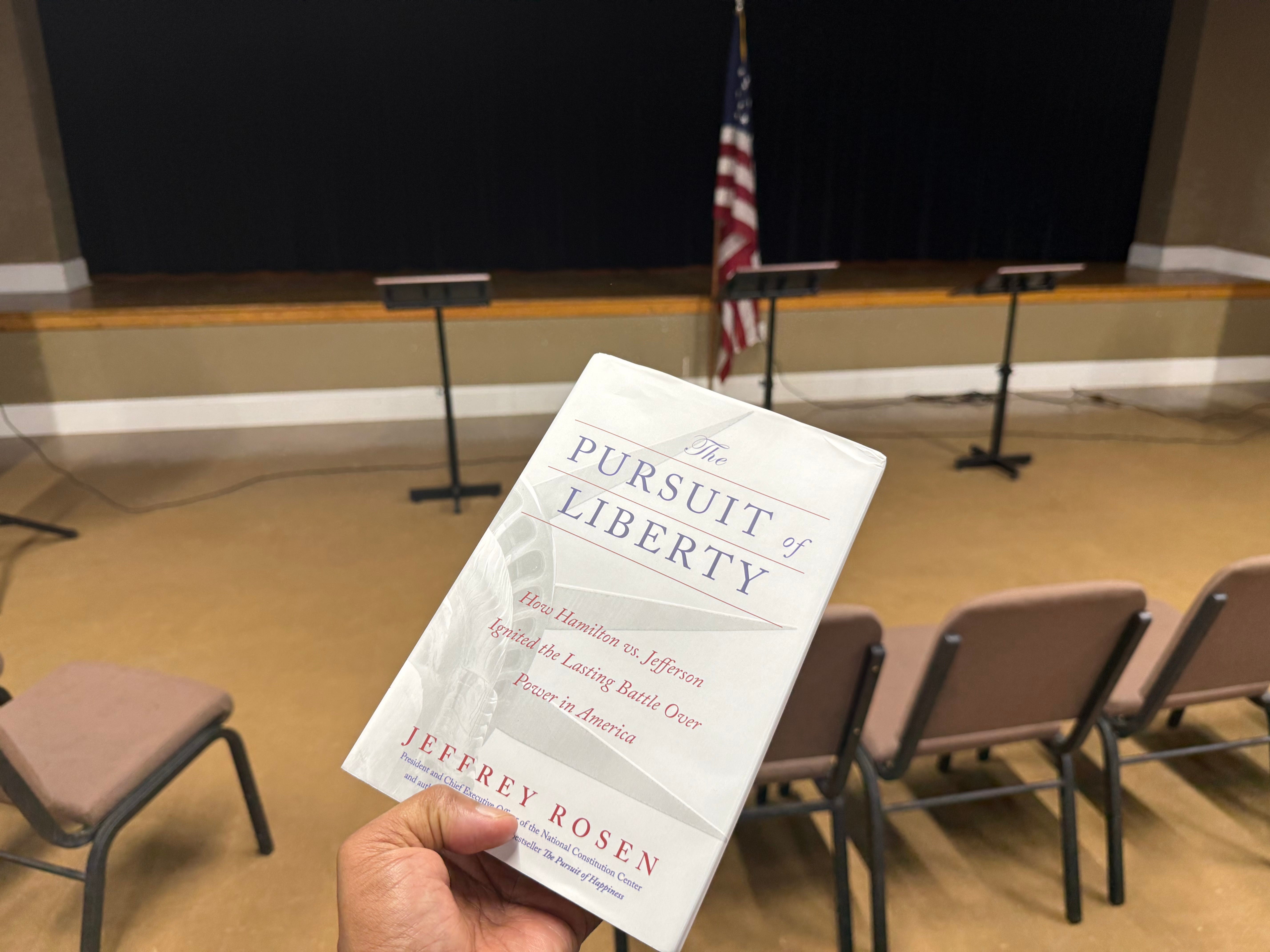
The Room Before the Room Filled
I finished the final chapter of Jeffrey Rosen’s The Pursuit of Liberty sitting near the front of a room inside the Link Centre in Tupelo, Mississippi.
Around me stood three podiums, three microphones, two sound system speakers, rows of chairs, and an American flag in front of a dark stage curtain. The room sat quiet. Waiting.
I had arrived about two hours early to set everything up myself.
I had done this in several other counties: organize a town hall, reserve the venue, invite the other two candidates in the race—Scott Colom and Senator Cindy Hyde-Smith—and give voters a chance to ask questions of the people seeking to represent them in the United States Senate.
On paper, it seemed simple.
Three candidates.
One room.
Voters with questions.
There is something revealing about a room before people arrive. The chairs sit in straight rows, full of expectation. The microphones wait to carry voices that may or may not come. A podium stands like a promise.
A podium is not just a piece of furniture. It is a place where a candidate is supposed to stand and explain themselves. It is where ambition meets accountability. It is where talking points are supposed to collide with real questions from real people.
That day in Tupelo, I arranged the room because I still believe voters deserve to see candidates side by side—not through campaign ads, edited clips, consultants, spokespeople, party machinery, or press releases, but in person, in public, in the same room, answering to the same voters.
That should not feel radical.
But in our politics today, it almost does.
After I finished setting up the microphones and speakers, I sat near the front and opened Rosen’s book. I was in the final chapter, the kind of chapter that feels different because you can sense the author beginning to land the plane, tying together the questions that have followed you from page to page: liberty, equality, self-government, citizenship, and the obligations of a republic.
Those ideas were still running through my mind when the building manager peeked into the room and introduced herself. I stood, shook her hand, and handed her the check for the cost of reserving the venue.
It was a small, ordinary exchange. But it mattered to me.
We had paid for the room. We had paid for the food. We had set up the microphones, speakers, chairs, and stage. We had done the work to create a space where voters could hear directly from the candidates seeking to represent them.
Then she left, and I went back to reading.
Quiet settled over the room again. I held the final chapter in my hands. And Jefferson and Hamilton’s old argument no longer felt confined to the pages of history.
It was present in that room — in the distance between the stage and the chairs, between public power and public accountability, between the candidates who had been invited and the voters who were beginning to arrive.
The Old Argument, Still Alive
Claude Bowers wrote in 1925 that “all American History has since run along the lines marked out by the antagonism of Jefferson and Hamilton.”
Nearly a century later, sitting inside the Link Centre in Tupelo, Mississippi, I understood exactly what he meant.
Jefferson feared power drifting too far from the people. Hamilton feared a government too weak to hold the Republic together.
Jefferson worried that centralized authority could become monarchy by another name. Hamilton worried that without national strength, the promise of the new Republic would collapse under its own weakness.
America has been arguing between those two instincts ever since.
At our best, we have needed both. We need institutions strong enough to protect rights, defend democracy, build infrastructure, regulate abuses, and make sure the powerful do not crush the vulnerable. But we also need those institutions to remain accountable to ordinary people.
Government must be strong enough to serve, but not so distant that it forgets whom it serves.
That afternoon in Tupelo, the old argument did not feel abstract. It felt local. It felt immediate. It felt like a room where the people had been invited, the candidates had been invited, and no party leader or political consultant had pre-screened the questions.
It was democracy in its simplest form.
And that may be why it was so revealing.
When the Forum Became a Circle
About thirty minutes before the 6:00 p.m. start time, I was fairly certain the other two candidates were not coming.
Not because anyone had called to say so.
Not because anyone had sent word.
But because by then, I had seen the pattern.
The setup was ready. The microphones worked. The voters were beginning to arrive. But the other candidates were not.
Then the food arrived.
A local caterer, The Salty Pig, brought in pulled pork sandwiches my campaign had paid for, just like we had paid for the venue. The smell of barbecue filled a room arranged for a candidate forum that was starting to look like it would not become a forum at all.
Soon, I could see that the sandwiches outnumbered the people in the chairs.
That could have felt disappointing. Politics trains people to count everything: how many people came, how many chairs were filled, how many cameras showed up, how many donors responded, how many clicks, views, shares, likes, and headlines the event produced.
But I have always believed the number of people in the room does not determine the value of the people in the room.
Every voter matters. Every question matters. Every person who takes time out of their evening to participate in democracy deserves to be treated like the room is full.
So we stopped pretending the room needed to perform disappointment.
We moved the chairs out of rows and pulled them into a smaller circle. I sat in the middle. And the evening became what democracy is supposed to be: not a performance from a stage, but a conversation among citizens.
The Voters Came Prepared
There is a kind of democracy that happens from a stage. A candidate stands behind a podium. The audience sits in rows. The microphone points one way. The room has a front and a back.
But there is another kind of democracy that happens in a circle.
No one sits far away. No one hides in the back. No one has to raise their voice to be heard. You can see people’s faces. You can hear the hesitation before a hard question. You can see the nods when someone says what others have been thinking. You can feel the room shift from audience to community.
That is what happened in Tupelo.
There was a nurse in purple scrubs, a mother of two young adults, who understood healthcare not as a talking point but as daily work. There was a young man in his mid-to-late twenties wearing a black shirt and multiple piercings, part of a generation trying to build a life in an economy that too often feels stacked against them. There was a father in a plaid shirt who had brought his tenth-grade son, the young man wearing a Cubs cap and sweater. They had recently visited Wrigley Field to see the Chicago Cubs play, and before we began, we talked about baseball, Chicago, and whether they had tried Chicago-style pizza.
There was also a young woman in her early thirties wearing a powder blue dress, listening carefully, asking questions, and bringing her own concerns into the room.
That is what democracy looked like that night—not television cameras, consultants, party officials, or a polished, stage-managed production, but a nurse, a father, a son, a young man trying to make sense of his future, a young woman worried about the direction of the country, a circle of chairs, pulled pork sandwiches from The Salty Pig, and questions that deserved answers.
I started by telling them why I had come.
“I’m visiting counties across Mississippi,” I said. “The purpose is to do something a little different. Create a space where community members can come in and ask the questions. You moderate it. The people control the conversation.”
I looked around the circle.
“There’s a lack of trust between voters, community members, and elected officials,” I told them. “And that’s not the fault of the voters. It’s the fault of elected officials.”
The voters in that circle proved the point. They had not come casually. They had come ready.
The woman in the powder blue dress looked down at the questions she had saved on her iPad.
“Americans right now are dealing with an affordability crisis beyond just the tariffs,” she said. “And if the tariffs went away tomorrow, prices still may not go down, because corporate greed is real. So from a position of government, how can that be addressed?”
That was not a talking-point question. That was a working-person question. And it deserved a serious answer.
She was not asking for resentment. She was asking for fairness. She was asking why working people pay taxes from every paycheck while the wealthiest people in the country seem to live under a different set of rules.
She talked about billionaires becoming trillionaires while working-class people struggle to pay for gas, groceries, housing, and basic needs. She talked about a minimum wage that feels lower than the cost of a pound of ground beef at the grocery store.
That is not abstract policy.
That is life.
That is what people are feeling.
The young man in the black shirt, sitting next to me, scrolled through questions he had prepared on his iPhone.
“What can actually be done about voting rights and gerrymandering?” he asked.
His question went straight to the machinery of democracy. Because if politicians can draw the lines to protect themselves, then voters are no longer choosing their representatives in the way democracy demands. They are being handed false choices inside a system already shaped to protect those in power.
The nurse in purple scrubs was thinking about the future too. As a mother of two young adults, she worried about what we are leaving behind for the next generation—not just the debt or the broken institutions, but the habits, anger, division, and cynicism. The feeling that every problem becomes a weapon, but too few problems become a priority.
And then there was the tenth grader in the Cubs cap.
He asked some of the best questions of the evening.
At one point, he leaned forward and asked whether college athletes have to pay taxes on NIL money.
“I’m not sure,” I told him.
Then I paused.
“And I’m not going to pretend I know something I don’t.”
In politics, that should not be rare. But somehow, it has become rare enough to notice.
His question opened the door to something larger. He was looking at a country where even college sports, something many young people grow up loving, now seems wrapped in contracts, tax consequences, branding, and money.
And later, he asked the kind of question adults often avoid because it is too simple and too true.
“Why does it seem like elected officials are always arguing,” he asked, “but nothing ever gets fixed?”
The room got quiet in that way rooms get quiet when someone says the thing everybody already knows.
That question stayed with me because it cut through everything: the noise, cable news panels, party talking points, fundraising emails, and performative outrage.
A tenth grader looked at American politics and asked what millions of Americans are asking: If all these people are in charge, why does so little get solved?
The candidates did not just miss an event.
They missed prepared citizens asking the questions democracy depends on.
The Same Two Roofers
The tenth grader’s question gave me a chance to explain the way I see this moment.
Since 1977, there have been six different periods when one of the two major political parties controlled the White House, the Senate, and the House of Representatives at the same time. Both parties have had their chances to govern. Both parties have had opportunities to address healthcare, education, housing, wages, money in politics, and the growing divide in this country.
And yet here we are.
Still arguing about many of the same things. Still watching healthcare costs crush families. Still watching housing drift out of reach for young people. Still watching schools fight for resources. Still watching working people pay more than their fair share while wealthy families use loopholes written into the law.
So I gave them the example I often use.
“If your roof has a leak,” I told them, “and you hire the same two contractors for 49 years, and 49 years later your roof still leaks—and the contractors are standing in your front yard pointing at each other and arguing about which one hasn’t fixed the leak—are you going to hire the same two roofers again?”
A few people nodded.
Because everybody understands a leaking roof. And everybody understands the frustration of watching the people hired to fix it spend more time blaming each other than stopping the water from coming in.
That is where we are. Education. Healthcare. Housing. Division. Corruption. Money in politics. The roof is still leaking.
And the same two political parties keep asking us to hire them again.
At some point, voters have a right to say no. At some point, voters have a right to say we are tired of the same excuses, the same promises, the same fear tactics, and the same results.
At some point, voters have a right to choose something different.
When Money Supersedes Voice
One of the most important questions of the night came through the discussion about money. Not just money in politics, but money as power, money as permission, money as the thing too many people now believe decides what is possible before voters ever get a chance to speak.
One question came up that follows nearly every Independent campaign:
“How can you win if you don’t raise the most money?”
My answer is simple.
“When did we bend the knee as Americans?” I asked. “When did we take a knee and say money supersedes our voice?”
That question hung in the circle for a moment.
Because every person in that room knew what money has done to our politics.
“When did the first question about a candidate become not ‘What do you believe?’ or ‘What are your values?’ or ‘What will you fight for?’ but ‘How much money did you raise?’”
That question matters because a democracy that worships money will eventually stop listening to people. And that is what has happened too often in America.
Billionaires and corporations do not wait until after elections to influence government. They invest early. They pick candidates. They fund campaigns. They support PACs. They shape what issues get discussed and what issues get buried. They also help shape who gets treated as viable, who gets invited onto major news networks, who gets covered as serious, and who gets ignored until voters are told they have no real choice.
By the time voters get to the ballot box, too many choices have already been filtered through money. That is not democracy at full strength. That is democracy with a price tag attached.
And working people know it.
They may not know every filing deadline, every PAC structure, or every loophole in campaign finance law. But they know when the system is not working for them. They know when elected officials seem more responsive to donors than to constituents. They know when the people writing the checks have more access than the people paying taxes, raising children, caring for patients, teaching students, farming land, and working two jobs to keep the lights on.
That is what the woman in the powder blue dress was pressing on when she asked about tax policy.
Ordinary people earn wages, and those wages are taxed. A nurse earns a paycheck. A teacher earns a paycheck. A farmer earns income. A college student working a job files taxes on what they earn.
But some of the wealthiest people in America are able to structure their lives so that their wealth grows without being treated like ordinary income. Their stock increases in value. They borrow against it. They live off loans. They avoid triggering the kind of taxable income working people cannot avoid.
And then, when appreciated assets are passed down, loopholes allow wealthy families to protect enormous gains from being taxed the way ordinary people would expect.
That is not an accident.
That is a design.
And politicians protect that design because the same wealthy donors who benefit from those loopholes help fund the system that keeps the same politicians in power.
So when people ask why we cannot afford universal healthcare, universal childcare, better schools, stronger infrastructure, or real support for working families, the first question should be:
In the wealthiest country on the planet, who is not paying their fair share?
Because working people are paying. Middle-class families are paying. Poor families are paying. The question is who has enough power to avoid paying.
Money distorts democracy in another way too. It is not only through tax loopholes or campaign checks. It is also through maps, access, and control.
The young man’s question about voting rights and gerrymandering brought us back to democracy itself.
“The Senate is one of the last guardrails we have left,” I told them.
Gerrymandering has badly distorted the House of Representatives across this country. In too many districts, mapmakers effectively decide the election before voters cast a single ballot in November. Candidates do not compete for the center of their communities. They play to the safest corners of their base.
And now states are engaged in gerrymandering wars, fighting each other through maps, moving the lines of democracy for partisan advantage.
That is dangerous. That is why voting rights matter. That is why the John Lewis Voting Rights Act matters. That is why independent redistricting commissions matter. That is why we have to stop allowing politicians to draw districts for the purpose of protecting themselves.
If voters cannot choose their representatives, then representatives will stop listening to voters. And if representatives stop listening to voters, the room gets quieter. The town halls get smaller. The people stop expecting answers.
That is how democracy weakens.
Not all at once.
Slowly.
By lowering expectations until absence feels normal.
What Democracy Requires
The empty podiums still mattered, but not because they were the whole story. They mattered because of what the voters had brought into the room: prepared questions, real concerns, open minds, a willingness to listen, and a willingness to challenge.
The voters deserved the chance to compare us side by side, not through ads, filtered statements, or partisan assumptions, but in person, in public, in their own community.
That is what democracy requires—not perfection, but presence; not performance, but accountability; not carefully managed distance, but respect.
I do not write this because I was offended that my opponents did not come.
I write it because the voters did.
I wondered what the room might have looked like if all three candidates had announced they were coming: more chairs filled, more reporters, more energy, more people believing something important was happening because the candidates themselves had treated it as important.
That is part of what gets lost when candidates avoid joint public forums. It tells people not to expect too much. It teaches communities to lower their standards.
And in Mississippi, that lowered standard has started to feel normal.
Candidates rarely debate each other. They often avoid shared stages. They campaign around voters instead of directly before voters. They speak to friendly crowds that already agree with them, take safe questions, and avoid rooms where citizens can compare candidates side by side. Over time, that absence becomes more than strategy. It becomes a culture. And that culture drains the lifeblood out of democracy.
But that night in Tupelo, the people in the room refused to let democracy die because two candidates refused to appear. We changed the room, abandoned the format, and let the conversation deepen.
The Jeffersonian part of me saw that circle and recognized democracy close to the people. The Hamiltonian part of me heard the questions about healthcare, housing, voting rights, taxes, wages, corruption, and congressional stock trading and remembered that government must be strong enough to act.
I do not see those commitments as contradictions. I see them as the balance America has always needed: a democracy rooted in the people, a government capable of serving them, and a politics close enough to hear ordinary citizens and strong enough to do something about what they say.
Maybe that is why the evening felt so personal.
I do not come from a family that could afford to ignore government. My father worked farms his whole life. I chopped cotton as a teenager. I grew up around people who lived with decisions made by people who never had to look them in the eye.
When prices went up, we felt it. When jobs disappeared, we felt it. When healthcare was out of reach, families like mine felt it. When schools lacked resources, children like me felt it. When politicians made promises and then vanished, communities like mine lived with the consequences.
That is why I do not take any voter for granted. Not one. Not a room of five. Not a room of fifty. Not a room of five hundred.
A voter who shows up deserves respect. A voter who asks a question deserves an answer. A voter who cares enough to come out after work, sit in a community room, eat a pulled pork sandwich, and talk about the future of the country deserves a democracy that looks them in the eye.
Near the end of the evening, I challenged the people in that room to keep going.
“People do not have to wait for candidates to create democracy for them,” I told them. “You can create the room yourselves.”
A church can do it. A civic group can do it. A student organization can do it. A neighborhood association can do it. A veterans group can do it. A local nonpartisan organization can do it.
“You can set the date,” I said. “You can invite every candidate. You can ask the questions. And then you can let the public see who respects you enough to show up.”
That is how we rebuild civic muscle—county by county, room by room, question by question, circle by circle.
When I think back on that evening in Tupelo, I do not think first about who was missing.
I think about who was there.
The woman with tax questions saved on her iPad.
The young man with voting rights questions on his iPhone.
The tenth grader in the Cubs cap asking why adults in power argue so much and fix so little.
The nurse in purple scrubs wondering what kind of country we are leaving behind for the next generation.
They are the reason I keep traveling across this state. They are the reason I keep answering questions. They are the reason I refuse to accept the idea that Mississippi voters should be managed, ignored, or taken for granted.
And that is why I am running as an Independent Veteran for the United States Senate.
Jefferson and Hamilton argued over the future of the Republic because they both understood that the American experiment was never guaranteed. It had to be built, fought over, defended, and improved.
The question of who democracy belongs to followed me from the final chapter of Rosen’s book to the circle of chairs inside the Link Centre..
The planned forum did not happen.
Something more honest did.
The people came.
They asked.
They listened.
They challenged.
They refused to lower their expectations.
And that is what I remember most.
Democracy does not belong to those who refuse to show up.
It belongs to the people who do.
Positive Energy Wins the Day—Every, Single, Time.
~ Ty
A great piece on civic engagement and political responsibility. I hope this reaches a very wide audience because it must be read - or listened to - by every voter regardless of Party affiliation, if any.
Thank you for sharing your moving commentary about the meeting in Tupelo. We the people must take back our government from the oligarchs who fund candidates who will serve their interests but not those of the citizens who they were elected to represent. I will continue to support your candidacy.